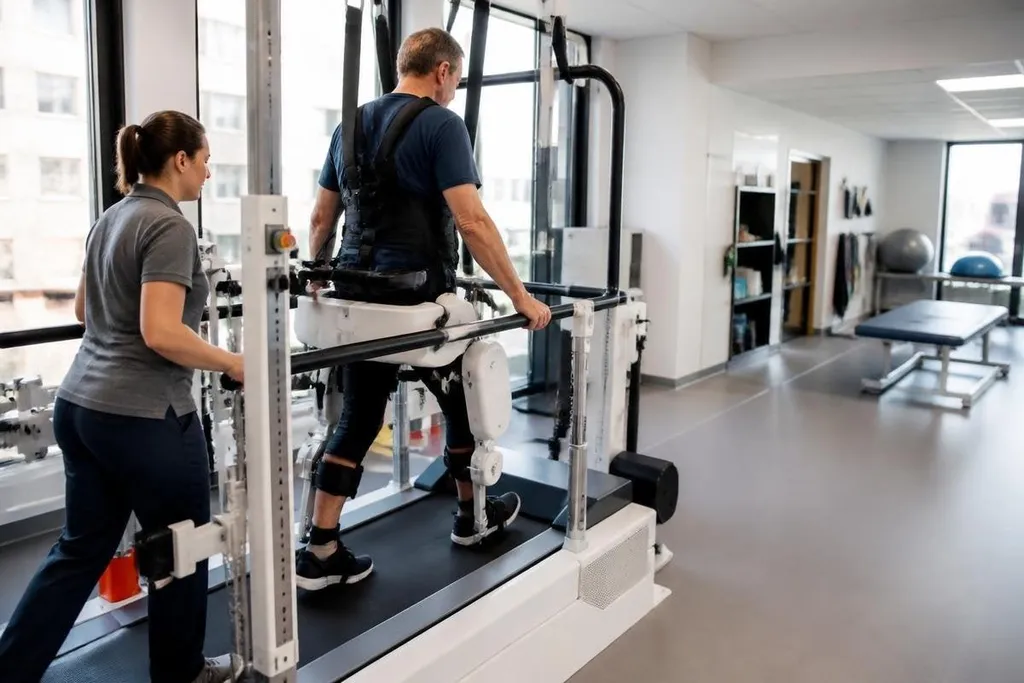
A therapy robot can repeat the same movement hundreds of times while measuring how much help a patient needs. That makes it useful for walking practice, arm movement, and strength work, but the therapist still decides what the patient should do and when to stop.
- Robots can guide repeated movements and record force, speed, and range of motion.
- Exoskeletons support the hip and knee joints during walking practice.
- The main limit is fit: a robot built for one movement may not help with daily tasks.
Repetition with less strain
Physical therapy often depends on repeated practice. Someone recovering from a stroke, spinal cord injury, or knee surgery may need to repeat a movement many times, yet pain, weakness, or poor balance can limit each session.
A robotic arm can guide the patient’s hand along a set path. The arm can add help when the patient struggles, then reduce that help as control improves. Force sensors measure how hard the patient pushes or pulls, while software records the path and the time needed to finish it.
That record gives the therapist more than a score at the end of a session. It can show whether the patient moves with less help, reaches farther, or slows down after several repetitions. The therapist can then change the task rather than guessing from one short attempt.
Walking practice and body weight
Lower-body systems take a different approach. An exoskeleton supports the legs at the hip or knee and guides part of the walking pattern. A treadmill system may also hold some of the patient’s body weight, leaving less load for weak legs to carry.
The amount of help can change during a session. A therapist might start with more body-weight support and a slower treadmill speed, then adjust those settings as balance and leg control improve. The robot does not decide that progress has happened; the clinician checks the person’s movement and symptoms.
Walking also requires more than moving one joint. A patient must shift weight, place each foot, react to changes, and stop safely. A machine can repeat a set gait pattern, but a clinic still needs tasks that match the person’s home, work, and street environment.
What the data can and cannot show
Robotic systems record numbers such as joint angle, movement speed, force, step count, and time under assistance. Those measures help a therapist compare sessions, but they don't describe the whole recovery.
Even when someone moves farther on a robot, they may still struggle to stand from a chair. Pain, fatigue, confidence, attention, and balance can change from one day to the next. A clean graph does not replace a clinical exam.
A therapy robot’s value depends on more than distance or repetitions. Rehabilitation robotics at Robot24.com can put recovery claims beside the device, task, and test setting. That record matters before checking how the system stops beside a patient.
The robot also needs a safe stopping method. A therapist must be able to pause the system, remove the patient quickly, and change the settings without waiting for a remote operator. The harness, straps, foot supports, and emergency stop must fit the person in front of the machine.
Where clinics need care
Cost, space, training, and patient fit all shape the case for a therapy robot. A clinic may need a large treadmill room for walking equipment, while an arm system may need a clear area around the patient and therapist.
The machine also works best when the exercise has a clear purpose. Repeating a movement for its own sake can waste time if the patient needs to practise reaching for a cup, standing from a chair, or turning toward a door.
The evidence question matters too. A robot can show that it helped a patient complete more repetitions, but that does not by itself prove better results after the patient leaves the clinic. Those claims need controlled clinical studies and follow-up over time. I’d treat any machine that promises recovery without naming its limits as a purchase risk.
A practical check before buying
A clinic comparing systems should ask:
- Patient group: Which diagnosis and movement does the system support?
- Therapist control: Can staff change assistance, speed, range, and stopping limits during a session?
- Measured data: Does it record force, joint angle, repetitions, or another useful measure?
- Safety steps: Can staff stop the robot and remove the patient quickly?
- Daily task link: Does the exercise match a movement the patient needs outside the clinic?
- Total cost: What room changes, training, service, and replacement parts add to the purchase price?
Those answers separate a useful therapy tool from a machine that mainly produces neat charts.
Robotics can take on repeated, measured work, while the therapist handles judgment, communication, and changes that the machine cannot see.
The next test is simple: does more robot-guided practice lead to better movement in the patient’s own daily life, after the robot is switched off?